
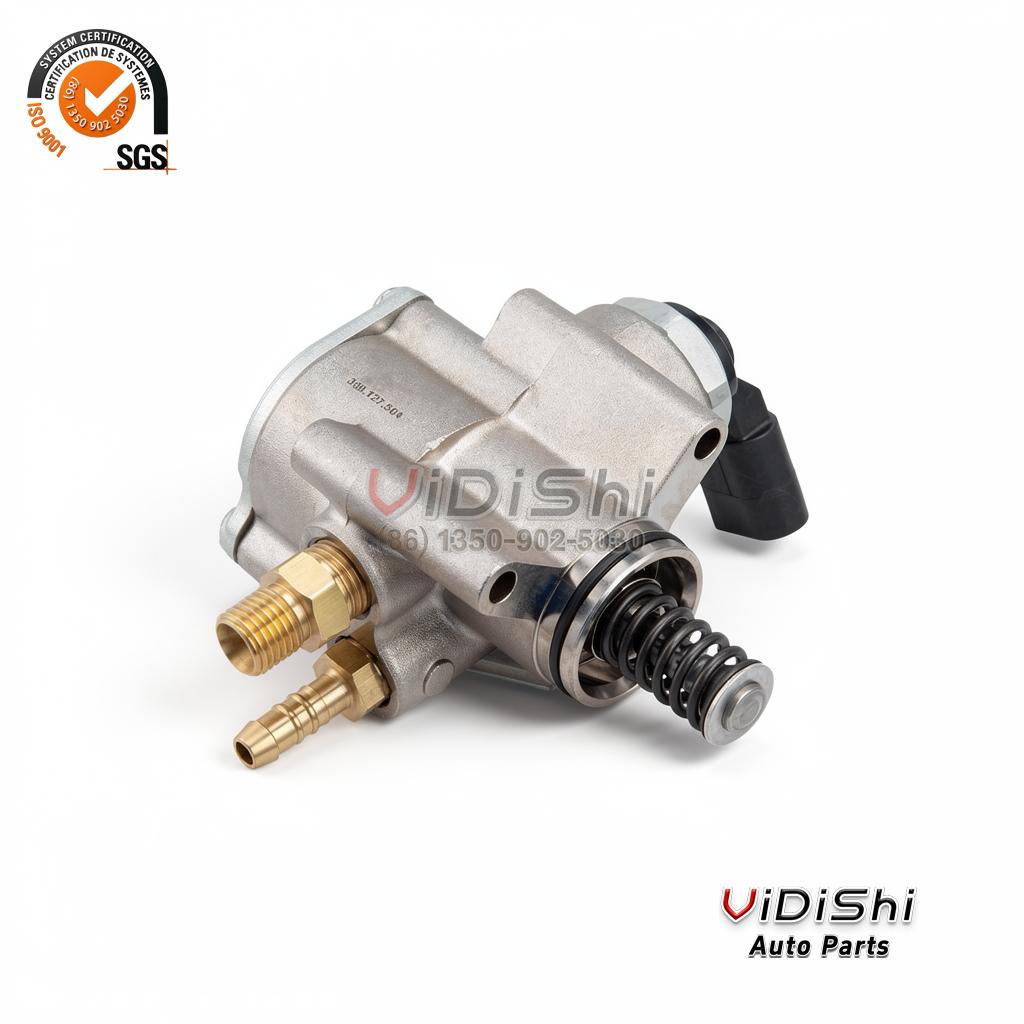
079127026C Right High Pressure Fuel Pump for Audi VW 4.2 V8
New right-side high pressure fuel pump 079127026C for the Audi and Volkswagen 4.2 V8 FSI petrol engine, cast number 079.127.026C read off the body of the supplied unit. The Hitachi cross reference is HFS853104D, with 2503087 and 133086 published against the same family and 079127025C covering the left-hand pump, because the 4.2 V8 carries one pump per bank. Seal 03H127307A is a companion part at fitting. Audi and Volkswagen are named as the application only. A Vidishi Auto compatible replacement, not a Hitachi-branded product, with a 12-month warranty against manufacturing defects. Single package 20x16x14 cm and 2.4 kg gross are packing estimates pending confirmation. MOQ 5 pcs.
Original price was: $69.65.$42.90Current price is: $42.90.
100% Secure Checkout
Free Shipping Over $1099
Customer Satisfaction
International Shipping
Product Specifications
| Weight | 2.4 kg |
|---|---|
| Dimensions | 20 × 16 × 14 cm |
| make | |
| model | |
| engine | |
| position |
Product Details
Supply highlights
The commercial numbers that decide the order, for a pump supplied new from a five-piece minimum with no core return.
Fitment verification in four steps
The application for this number is published, so the check is quick — but the published sources disagree about the years, which is exactly why it still has to be done on your own unit.
| Step | What to look at | What it proves |
|---|---|---|
| 1. Read the cast number | The engraved number on the flank of the unit in the engine | Confirms 079.127.026C on the body rather than a number taken from a listing |
| 2. Confirm the side | Which bank the unit sits on, right or left | Confirms this number rather than 079127025C, which is the left-hand pump on the same engine |
| 3. Check the connector and ports | The two-pin connector and the two brass ports on the body | Confirms the unit matches the published part rather than a neighbouring member of the family |
| 4. Get written confirmation | Our reply before anything is invoiced | The match is agreed in writing, not assumed from a chart |
The application we stand behind is the 4.2 litre V8 FSI petrol engine in the 4163 cc configuration, across the Audi and Volkswagen models that use it — the 4.2 FSI quattro applications on the Audi side and the 4.2 V8 FSI on the Volkswagen side, and two things carry that application: the cast number on the body of your own unit, and the side it came off. We deliberately do not extend that to a model year range, because the sources we can cite overlap and contradict each other on exactly that point and a value we cannot stand behind twice is worse than no value at all. That is the petrol high pressure pump this engine was built with, and an order that starts from the pump coming off is the one that arrives correct.
Two more identifiers worth having. If the vehicle is still with the customer, the vehicle identification data on the registration document and on the windscreen settles the engine variant faster than any chart, and the engine code on the plate settles which build the vehicle left the factory as. Where the pump is already off the engine, a photograph of the engine code plate and a photograph of the cast number on the pump settle it instead. Any one of those three alongside the engraving is enough for us to confirm in writing; all of them together is what stops a number-range mix-up reaching your workshop.
Why the cast number matters more than the number range. The family this number belongs to carries many suffixed members, and the published sources place different suffixes on different engines and on different sides. That is the clearest possible demonstration that a number-range search is not a fitment check: two suffixes in one family can be a right-hand pump and a left-hand pump of the same engine, and they are not interchangeable in position. The casting tells you which one you are holding. Match it, confirm the side, and order.
What this page is not claiming. We are not saying that another suffixed member of the family fits your engine, that the left-hand pump is included in this line, that the companion seal ships in the box, or that a pump from a different family substitutes. 079.127.026C describes one unit in one position, and the casting on your own pump is what identifies it. Anything beyond those lines is better answered from your own parts data, and we would rather answer it with you than assert it here.
What a right-side high pressure fuel pump does on a V8 petrol engine
A plain-language look at the unit, the number cast into it, and why the side it sits on matters more here than on most pumps.
On a petrol direct injection engine the fuel system is split into a low pressure side and a high pressure side. A lift pump in the tank pushes fuel forward at low pressure. The high pressure fuel pump is what comes next, and it decides everything after that point: it raises the fuel to the pressure the rail needs, and the rail feeds the injectors on that bank of the engine. On a V8 petrol engine there are two banks, and on the 4.2 FSI each bank has its own pump. That single fact runs through this entire page, because it decides how many parts the job needs and what else has to be changed while the engine is open.
The second thing worth holding on to is the number itself. It is written in the vehicle group form as 079 127 026 C, and the body in the photographs is cast with the same digits in a three group form, 079.127.026C. That is not a coincidence of formatting; it is the reason a cast number is the most reliable identifier on a part like this. Listings get copied, numbers get transcribed, and a listing that concatenates a pump with a valve and three other makes is exactly the kind of record where the number on the page and the number on the metal drift apart. The metal is the one that settles it.
A V8 splits into two banks of four cylinders, and it is worth saying plainly that the engine runs on four strokes while the fuel system around it does not care which stroke the piston is on. The third thing is the failure mode, and on this engine it is unusual enough to change how you plan the job. The reported failure is an internal seal letting fuel out of the high pressure side and into the crankcase, rather than a pump that simply stops delivering. Fuel in the oil is what turns a pump replacement into an engine repair, because the oil is what the bearings run on. That is why the published guidance on this application is to replace both pumps and change the oil and the oil filter in the same visit, and why the symptoms section below spends more space on the oil than most pump pages do.
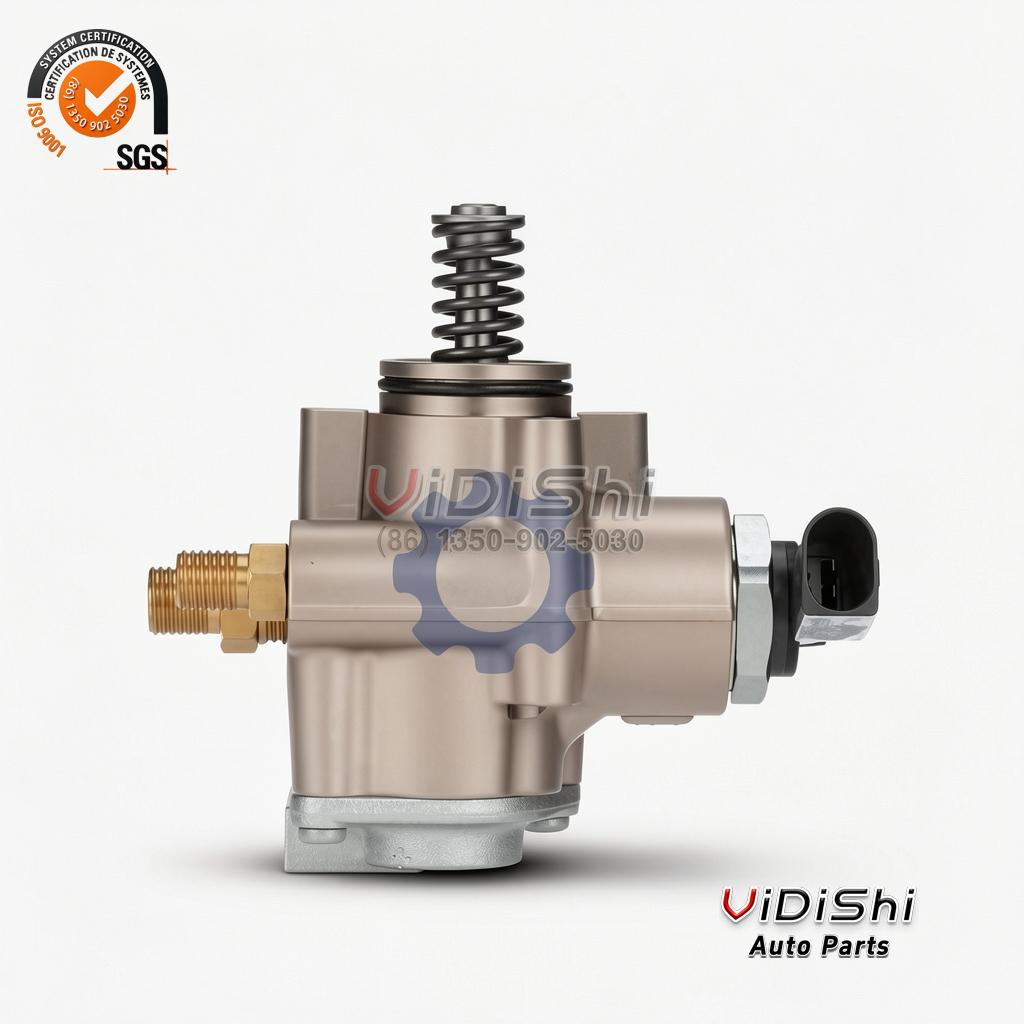
What the photographs show is the unit as it comes off the shelf line for this number: a cast body, a spring-loaded plunger assembly in a machined bore, a two-pin electrical connector on the body, a brass male thread port and a brass push-fit hose tail, and a cast mounting base. What we will not claim is what is inside it. No source we can stand behind publishes whether the internal oil and seal set is assembled before dispatch for this number, so that is confirmed against the packing list rather than asserted here, and it is listed as not published in the specifications table below rather than quietly assumed.
Where our supply differs is what arrives rather than how the part works. Original equipment supply comes through the manufacturer’s own channels, and a buyer whose paperwork requires a factory boxed part does need to go there. What we supply is a high pressure pump replacement — a new compatible unit for the same job, sold under the Vidishi Auto brand, cast with the same number, at a five-piece minimum with no core return. That last point matters on this job more than on a routine injector change: nothing has to come back, there is no exchange loop to manage, and the removed pump stays with you for the warranty file.
One thing we do not do is dress that up. The 079127026C pump we ship is ours, not a manufacturer’s and not a vehicle maker’s. The part numbers, the reference series and the vehicle group form appear on this page so you can match the pump you are replacing. They are references for fitment and for searching, not a claim about who made the part. Any origin information associated with a reference unit describes that reference unit rather than the goods we supply, which is why no country of manufacture is claimed anywhere above. The buying guides hold the general method for confirming any fuel system part from the unit itself, and the glossary explains the terminology if any of the names above are unfamiliar.
079127026C specifications
Confirmed values first, then the parameters we deliberately mark as not published rather than guess. The second table is long on purpose: on a pump of this type most of the figures a buyer might want sit inside the calibration data, and saying so is more useful than printing an approximation.
| Part number | 079127026C (supplier number for this listing) |
| Number in vehicle group form | 079 127 026 C, the same number written in the group form (Confirmed — the flank of the supplied body is engraved 079.127.026C) |
| Reference series | HFS853104D (Reference — published catalogue number for this unit, an identification reference only) |
| Further published numbers | 2503087, 133087, 706032240, 8TH 358 345-251, HPP0022 (Reference — all catalogued against the same unit) |
| Earlier number for the same unit | 079127026AB (Reference — the earlier suffix published as the replacement for this number on the same engine and the same side) |
| Part type | High pressure fuel pump, right-hand side |
| Injection system | Direct injection petrol, high pressure side of the fuel system |
| Fitting position | Right (Reference — published fitting position for this number) |
| Engine | 4.2 litre V8 FSI petrol, 4163 cc (Reference — published engine configuration for this number) |
| Engine codes published | BNS and BVJ (Reference) |
| Body and plunger | Cast body with a spring-loaded plunger assembly and a machined mounting base (Confirmed from the supplied photography) |
| Electrical | Two-pin black connector on the body, protected (Confirmed) |
| Ports | One brass male thread port and one brass push-fit hose tail on the body (Confirmed) |
| Paired pump | 079127025C and 079127025AF cover the left-hand pump on the same engine (Reference — the left-hand unit is a separate order) |
| Companion seal required | 03H127307A (Reference — published as an article required in addition to the pump) |
| Fuel | Petrol, fuel direct injection |
| Condition | New — Vidishi Auto compatible replacement |
| Supplied brand | Vidishi Auto — a compatible replacement part |
| Minimum order quantity | 5 pcs |
| Warranty | 12 months against manufacturing defects |
| Single package size | 20 × 16 × 14 cm (packing estimate, not a published figure) |
| Single gross weight | 2.4 kg (estimated, not a published figure) |
| Core return | Not required with our supply |
| Whether the internal oil and seal set is assembled | Not published — no source we can stand behind states the internal assembly state for this number, so it is confirmed against the packing list rather than asserted |
| Rated delivery pressure for this unit | Not published — the pressure figures attached to this family in seller and diagnostic pages are general rather than a figure for this number, and a pressure value printed in a product table ends up in somebody engine settings |
| Delivery rate and flow figures | Not published — withheld rather than approximated, and a guess in this cell would be worse than an empty one |
| Model year coverage | Not published — the published sources overlap and disagree on the year boundaries for this number, so the page prints no year range |
| Pressure regulating function figures | Not published — no catalogue we can cite publishes a regulating characteristic for this number, so no threshold or setting is given |
| Fuel type beyond petrol | Not published — one used-parts page describes this number as covering a diesel and a petrol configuration, which the published 4163 cc petrol engine data contradicts, so only petrol is stated |
| Members of the wider number family | Not published — the 079127026 family carries many suffixes and the sources place different suffixes on different engines and different sides, so only the earlier suffix for this same unit is reprinted here |
| Seat and Skoda applications | Not published — one catalogue lists this number under those two marques but no source gives a model or a year for either, so no application is claimed for them |
| Applications outside the published list | Not published — additional models appear only against other suffixed members of the family, so nothing outside the list on this page is claimed |
| Plunger stroke and cam phasing | Not published — both belong to the engine application, so the drive engagement and the figures are confirmed against the unit coming off and the engine manual |
| Electrical resistance and pin assignment | Not published — the connector is visible on the body but the electrical specification is not released for this number |
| Net unit weight and unpackaged dimensions | Not published — published weights and dimensions for this number conflict between sources, so only a clearly labelled packing estimate is given for the boxed pump |
| Country of manufacture of the goods supplied | Not published — any origin information associated with a reference unit describes that reference unit, not the goods we supply, and it is not restated here as a claim |
| Overhaul kit part number for this number | Not published — kits are catalogued against the wider family and a family kit number is not automatically correct for this variant |
How we label data. Confirmed means a value read directly from the goods we handle, including the number cast into the body and the connector and ports visible in the photography. Reference means a part number, a family designation or a cross reference quoted so your paperwork can be matched, and carrying no claim about origin. Not published means the field is left blank on purpose — a pressure figure, a component number or a fitment list that we cannot source would be worse than an empty cell, because it would end up in somebody’s parts order or somebody’s engine settings.
What is in the box. One right-side high pressure fuel pump: the cast body with its spring-loaded plunger assembly, the two-pin electrical connector, the brass male thread port and the brass push-fit hose tail, and the cast mounting base, as photographed. The companion seal 03H127307A, the left-hand pump, the engine oil and the engine oil filter are not in this line and are named on this page so the whole job can be planned before the vehicle goes onto the ramp. Whether the pump is supplied with its internal oil and seal set assembled is confirmed against the packing list rather than claimed here.
Cross reference and how to read it
The numbers that resolve to this pump, and what each one is. This is a map of one unit in one position, not a list of interchangeable parts.
| 079127026C | Supplier part number for this listing, and the number on the body in the photograph (this unit) |
| 079 127 026 C | The same number written in the vehicle group form (Confirmed) |
| 079.127.026C | The same number as cast into the flank of the supplied body, in three group form (Confirmed) |
| 079127026AB | Earlier published suffix for the same unit on the same engine and the same side (Reference) |
| 079127025C | Left-hand pump on the same engine, a separate order (Reference — not a claim that it fits this position) |
| 079127025AF | Further published number for that left-hand pump (Reference) |
| HFS853104D | Reference series number catalogued against this unit (Reference — identification and search only) |
| 2503087 | Further published catalogue number for this unit (Reference) |
| 133087 | Further published catalogue number for this unit (Reference) |
| 706032240 | Further published catalogue number for this unit (Reference) |
| 8TH 358 345-251 | Further published catalogue number for this unit (Reference) |
| HPP0022 | Further published catalogue number for this unit (Reference) |
| 03H127307A | Companion seal published as required in addition to the pump (Reference — a separate order) |
Read the table from the top, because the order matters. The first three rows are the same number written three ways, and all three are the strongest identifiers on the page: the supplier number, the vehicle group form, and the engraving actually on the flank of the body you can see in the photograph. Used as a 079127026c cross reference map, the table settles the part before it settles the price. If those three agree with your own unit, the part is identified. The row that would identify it wrongly is a number that came from a listing rather than from the metal, which is the failure this page is built to prevent.
The HFS853104D row and the four rows beneath it are there for identification the way a catalogue reference is on any parts entry, and they are worth reading with care. They tell a parts clerk which published numbers resolve to this unit, which matters because your own paperwork may carry the reference series rather than the vehicle group form, and a search box that only knows one of the two will tell you the part does not exist. They are not a statement that the unit in our box was made by that manufacturer, because it was not, and the difference matters both legally and practically when a warranty claim has to be settled.
The two rows for the left-hand pump are the half of the mapping that stops people over-reaching, and they are here for a reason. On this engine the two sides are separate units under separate numbers, and the published fitting position for this number is the right-hand side. Quoting the left-hand number where the right-hand unit belongs is not a near miss that a fitter catches at the bench; on a V8 it is a job that comes apart again. That is why both numbers sit in the same table with their positions written next to them.
What the table deliberately does not do is extend itself. It does not say that another suffixed member of the family fits your engine, that the companion seal is in the box, or that a unit from a different family substitutes. The family this number belongs to carries many suffixes, and the published sources place different suffixes on different engines and different sides of the same engine, so reprinting the rest of the family as fitments would be inventing fitments. Those are exactly the assumptions that turn a cheap order into a second removal, and we would rather leave the cells empty than fill them with a guess. Our comparison charts set out the number families we can evidence, and the buying guides cover the general method for confirming any fuel system part from the unit itself.
Built for a one-pump-per-bank engine, supplied as a complete unit
What this pump gives a workshop that orders around the fault rather than around the cheapest line item.
Right-hand unit for a one-per-bank engine
The 4.2 litre V8 carries a pump on each bank, and this number is the right-hand one. The left-hand pump is a separate number and a separate order, which is the fact most often missed when this engine is worked.
Cast number you can read before you order
The flank of the body is engraved 079.127.026C in three group form, so the match against your own unit happens before the pump goes anywhere near an engine.
A number that resolves in a parts system
HFS853104D, 2503087 and 133087 are all catalogued against this unit, so the part still finds its way when your paperwork carries the reference series rather than the vehicle group form.
Two-pin connector present and protected
The black connector on the body is capped as supplied, so the unit arrives complete rather than with an exposed terminal waiting to be knocked.
Brass ports ready to seal
A male thread port and a push-fit hose tail are both machined and clean on arrival, so the fuel circuit is closed from the moment the box is opened.
New, not an exchange unit
A new compatible pump rather than a reconditioned core, so there is no core return, no core charge and no wait for an old unit to be accepted before a replacement ships.
Five-piece minimum for stocking
This line starts at five pieces because it is bought for workshop and distributor stocking, and because a workshop on this engine has a real chance of needing both banks in the same visit.
Export packing that protects what matters
Each pump is boxed with the connector and the brass ports protected, because a bent connector pin and a scored port face are what turn a cheap part into a second removal job.
The practical difference shows up on the second bank. When one side of this engine has failed internally and the other is close behind, the choice is between replacing one pump and finding the second one weeping a month later, or replacing both while the engine is open. Keeping a matched spare on the shelf — correct cast number, correct side — turns a two-visit repair into a single-visit one. That is the case for stocking this line rather than ordering against each failure, and it is why the minimum on this page is a stocking quantity rather than a single unit.
How a tired high pressure fuel pump behaves on this engine
Read every line as a symptom rather than a verdict, because each of them has at least one other possible cause. What follows is the pattern, and the checks that separate a pump fault from the alternatives.
- A rich mixture code on one or both banks — The published failure mode on this engine is an internal seal letting fuel into the crankcase rather than the pump simply ceasing. That reads as a rich code on a bank, and the giveaway is the oil, not the code.
- Fuel odour at the oil filler — Where the leak is internal, the fuel reaches the oil. Smell at the filler cap and an oil level that has risen are the two checks that separate an internal pump failure from a metering or injector fault.
- Hard starting that is worse when warm — A hot-soaked engine that cranks long and catches reluctantly is a common companion on this application, and it is worth reading alongside the oil check rather than on its own.
- Misfires that follow load — A bank running rich loses combustion stability as the engine is worked, so the misfire count rises with demand rather than sitting constant at idle.
- Long-term fuel trim pushed negative — The control unit trimming fuel hard to correct a mixture that is already too rich is a strong indication that the fault is upstream of the injector, in the high pressure side.
- A pressure-related fault code on the rail — A code reporting fuel rail pressure below target belongs on the list. Read the scan data against target rather than the code name, because a code names a circuit and not always a part.
- Visible fuel at the seal face or the port joint — Weeping at the mounting face or at a port joint after a joint has been opened is a fitting symptom, and it is the one on this list that a new seal and a clean face will actually fix.
- An oil level that climbs between services — On this engine that is the single most important line on the list. If the level rises, stop driving it and check the oil before anything else, because the fuel in the oil is what turns a pump replacement into an engine repair.
The pattern worth holding on to is the one that arrives with the oil. A high pressure fuel pump on this application does not usually fail by stopping; it fails by letting fuel past an internal seal into the crankcase. That is why fuel odour at the filler and a rising oil level sit at the top of this list rather than a warning light, and it is why the oil is the first thing to check on this engine rather than the last. Our fault code guide explains how to read the data behind a code, and we would rather see your scan data and an oil reading than our guess at either.
The second pattern is about the bank rather than the part, and it changes what you do next. Because the engine has one pump per bank, a fault on one side shows up on the cylinders fed by that side and leaves the other bank steady. That single distinction does more diagnostic work on this engine than any code name, and it is what tells you whether you are replacing one pump or two. A rich code and a rich mixture on both banks at once is a different conversation from the same code on one bank, and treating them the same is how a second visit happens.
Fitting the pump, and the one step that decides the whole job
Written for a petrol workshop rather than for a first-time job. The order matters, and on this engine one of these steps decides whether the repair is finished or has to be revisited.
- Step 1. Read and record the cast number before anything is unbolted
Photograph the engraved number on the flank and write it down. On this application that number is the whole identification, and it is the one thing you cannot recover once the old unit is in a bin. - Step 2. Decide whether this is a one-bank or a two-bank job
The 4.2 V8 carries one pump per bank. If the engine has any sign of fuel in the oil, the answer is both sides, and that decision belongs before the first bolt is turned rather than after the second bank is found to be weeping as well. - Step 3. Drain, depressurise and mark the drive position
Let the engine stand, release residual pressure, and before anything is unbolted mark the position of the pump against its mounting face. The mark is the only thing that guarantees the new unit goes back on the same position. - Step 4. Clean around the pump and the port faces before opening anything
Wash down, blow the mounting face and both port faces clean, and only then release the bolts. Grit that lands on a machined surface ends up between the two faces and the new pump will weep from its first minute. - Step 5. Unbolt evenly and support the body
Work the bolts in sequence rather than freeing one corner at a time, and support the casting as the last one comes out. A body that drops onto its fitting is how a good replacement turns into a second job. - Step 6. Fit the companion seal rather than reusing the old one
Three independent listings name 03H127307A as an article required in addition to the pump. A fresh seal under the refitted pump is the cheapest part of the job and the one most often reused by mistake. - Step 7. Refit square and torque to the engine figure
Drop the unit into the marked position, bring the mount up evenly and torque to the figure for your engine. The figure belongs to the engine, not to the part, and we do not publish it for this number. - Step 8. If the old pump leaked internally, change the oil and the filter in the same visit
On this engine the published failure mode puts fuel in the crankcase. New pump, new seal, fresh oil and a fresh oil filter in one visit is the repair; a new pump on old oil leaves the damage the old pump already did in place. Prime and verify fuel pressure against target at idle and under load before the vehicle goes back to work.
Two notes on what we deliberately do not print. We do not publish the tightening figure for the mount, the delivery pressure, or the drive phasing, because all three belong to the engine application rather than to the part, and a figure copied from a product page into a workshop manual is how a good pump gets damaged on a correct fit. Take them from the engine manual for the vehicle in front of you. And we do not publish a torque figure as a shortcut, because the mount and the two port joints each have their own value and they are not interchangeable. The installation guide covers the surrounding routine, and the glossary defines the terms if any of the above are new to you.
Warranty and after-sales cover
What we stand behind on a pump, and what is outside the cover.
Every 079127026C pump is covered by a 12-month warranty against manufacturing defects. That covers a unit that arrives out of specification or fails early because of how it was made. It does not cover damage from contaminated fuel, from a filter changed too late, from incorrect fitting, from a drive coupling torqued beyond its figure, or from a separate fault elsewhere in the fuel circuit. It does not extend to labour, to the engine oil or to the vehicle. It is a supplier warranty from Vidishi Auto and it is not a Hitachi warranty and not an Audi or Volkswagen warranty — we are not a dealer for any of the equipment makers and no cover from any of them travels with this part.
If a pump is suspected faulty, send us the order reference, the cast number read off the unit you removed, which bank it came off, and your scan data. We will confirm the next step against our warranty terms and the returns process.
The one question we ask about every time is whether the engine oil was changed when the old pump came out, because on this application that is the single most common reason a replacement is followed by a second visit. An internal seal failure puts fuel in the oil, and a new pump on old oil leaves in place the damage the old one already did. Tell us what was done and we can tell you quickly whether a claim is likely to stand. If you would rather settle that question before you order, the contact page is the fastest route to a written answer.
Wholesale supply for workshops and distributors
A one-per-bank engine rewards stocking, so this line starts at five pieces and scales from there.
The minimum order quantity is 5 pieces, and the reasoning is worth stating rather than leaving you to work out. A pump on this engine is not bought against a breakdown on one vehicle; it is bought against a fleet of V8 petrol cars where the same unit fits every one of them, and where the second bank is usually close behind the first. Five pieces covers a workshop with a shelf spare for each side, and a distributor can hold the right-hand unit, the left-hand unit and the companion seal as a standing trio. From there the line scales normally, and mixed fuel system orders travel on the same export paperwork.
What we do not do on this line is pretend the part is something it is not. The unit we ship is a new compatible replacement sold under the Vidishi Auto brand. It is not Hitachi-branded, it is not Audi-branded or Volkswagen-branded, and it is not a factory boxed original. That matters commercially as well as legally: if your incoming goods inspection needs a specific brand on the paperwork, this is not that product, and we would rather tell you now than have a delivery rejected. The help centre covers ordering and documentation questions.
Packaging, shipping and lead time
How these pumps are packed, and what to expect on an export order.
| Single package size | 20 × 16 × 14 cm (packing estimate) |
| Single gross weight | 2.4 kg (estimated figure) |
| Minimum order | 5 pieces |
| Core return | Not required — supplied new, not as an exchange unit |
| Also needed at fitting | Companion seal 03H127307A, plus engine oil and oil filter when the old pump failed internally |
| Packing | One pump per box, electrical connector and brass ports protected |
| Documentation | Commercial invoice, packing list and HS code documentation supplied |
| Shipping | Export by courier, air or sea to your destination |
| Lead time | Quoted per order in writing before the invoice is raised |
The package size and gross weight in that table are a packing estimate, and we label it that way rather than quietly presenting it as a specification. No source we can stand behind publishes a packaged figure for this number, so we give you a figure we can pack and weigh against rather than a manufacturer specification we cannot evidence. If your freight is calculated on volumetric weight rather than actual weight, tell us the destination and we will confirm the chargeable weight against the carton we actually use. The shipping page sets out the full documentation and delivery terms, and the order tracking page is where to follow a shipment once it has left.
On the protective side, the two areas we watch are the electrical connector and the machined port faces on the body. A connector pin knocked out of alignment is a fault that looks like an electrical problem for weeks afterwards, and grit on a sealing face is a weep that gets blamed on the new unit. Both are packed protected on every pump, and both are worth checking on arrival before the box goes into stores.
Quality checks before a pump leaves us
How 079127026C is treated before it is packed for export.
A high pressure pump for a V8 petrol engine is a compact precision casting with a running surface inside it, so this line is checked at unit level rather than by sample. Every batch passes an incoming check for the number cast into the flank, a check that the spring-loaded plunger assembly moves freely in its machined bore, a confirm that the two-pin connector and both brass ports are present, undamaged and capped, a check that the port faces and the mounting face are clean and free of obstruction, and a packed-weight confirmation against the documented figure. The supplier shows an ISO 9001 system certification badge on the product photography, which we record as a supplier statement rather than as a certificate we issue.
Rather than publish reviews we cannot verify, we tell you what we will actually put in writing: a written fitment confirmation against the cast number you send us, a written quote against your quantity and destination, and a warranty position on any claim that follows. If you need a supplier who will sign a specific inspection or conformance document with the order, ask before you buy rather than after, because the answer depends on what the document is. The help centre covers the documentation we can provide, and the partner programme page is the route for a standing arrangement that needs more than a one-off order.
079127026C FAQ
The questions buyers ask most about this pump and the numbers it carries.
What part is 079127026C exactly?
It is the right-side high pressure fuel pump for the 4.2 litre V8 FSI petrol engine. Parts catalogues place this number on the high pressure fuel pump and mark its fitting position as the right-hand side of the engine, and the cast number engraved on the body of the unit supplied here reads 079.127.026C, so the part in the photograph and the number on this listing are the same item. The photographs show a cast body with a spring-loaded plunger, a two-pin connector, two brass ports and a cast mounting base. Whether the internal oil and seal set is assembled is not published for this number, so that is confirmed against the packing list.
Why does a 4.2 V8 need two of these instead of one?
Because the engine has one pump per bank, and this number is the right-hand one. The left-hand pump is catalogued under 079127025C and 079127025AF, and two independent manufacturer listings for this family give a paired article number, so the two are considered together. That is the most useful thing to know before you order on this engine, because replacing one bank and leaving the other is how a second tank of fuel ends up in the oil.
What happens when this pump fails, and why does the oil matter?
On this engine the reported failure mode is an internal seal letting fuel into the crankcase rather than the pump simply stopping. That shows up as a rich mixture code on one or both banks, fuel odour at the filler, and an oil level that rises. Because the fuel is in the oil, the repair is not complete until the oil and the oil filter are changed, and on this engine both pumps are generally replaced together. Skipping the oil change after a pump has leaked internally is how bearing damage happens, which is a far larger job than the pump.
How do I confirm the right pump before ordering?
Read the cast number on the body of the unit you are removing and photograph it. On this application the flank carries 079.127.026C in a three group form, and that is the check that matters. Then confirm the side: this number is the right-hand pump and 079127025C is the left-hand one, and the two are not interchangeable in position. Finally send us the vehicle identification data and the engine code from the plate. We reply with a written match confirmation before anything is invoiced.
What does HFS853104D identify?
It is a reference part number published against this same unit by a manufacturer catalogue, alongside 2503087 and 133087. Those numbers are what a parts database will match when your own paperwork carries the reference series rather than the vehicle group form, so they matter for searching rather than for fitting. They are reference numbers only. They do not make the part a manufacturer-branded product and they say nothing about who made the unit in the box, which is ours.
Which seal do I need with this pump?
Three independent listings for this number name 03H127307A as a companion article required in addition to the pump, so plan for that seal rather than assuming the pump alone completes the job. Beyond that seal, the fuel filter and the air filter service on this engine is part of the same visit, and the engine oil and oil filter are part of the job whenever a pump has failed internally. We list the pump on this line and the companion items are named here so the whole job can be planned before the vehicle goes onto the ramp.
Which engines does this pump fit?
The published application is the 4.2 litre V8 FSI petrol engine, in the 4163 cc configuration, across the Audi and Volkswagen models that use it. Engine codes published against this number include BNS and BVJ. We deliberately do not print a model year range, because the published sources for this number overlap and contradict each other on the year boundaries, and we will not print a value we cannot stand behind twice. The two things that settle it are the cast number on the body and the side it sits on, and we confirm both in writing against your vehicle data.
Is this a complete pump or a component?
What you receive is the pump as it comes off the shelf line for this number: the cast body, the spring-loaded plunger assembly, the electrical connector, the two brass ports and the mounting base, as photographed. What we will not tell you is what is inside it. No source we can stand behind publishes whether the internal oil and seal set is assembled before dispatch for this number, so that is confirmed against the packing list rather than asserted here. Nothing on this line is sold as a housing on its own, and if you want a component-level repair rather than a replacement, tell us before you order and we will say what that route needs.
What is the minimum order quantity?
Five pieces. This line starts at five because it is bought for workshop and distributor stocking rather than for a single breakdown, and because a workshop replacing a pump on this engine has a real chance of needing both the right and the left unit in the same visit. There is no core return and no core charge with our supply, because we sell new compatible pumps rather than exchange units, so nothing has to come back and there is no exchange loop to manage. Larger quantities and mixed fuel system orders travel on the same export paperwork.
What is the lead time and how does the pump ship?
Lead time is quoted per order rather than promised as a fixed number of days, because it depends on the quantity and on what else is travelling in the same shipment. Each pump is boxed with the electrical connector and the brass ports protected, because a bent connector pin and a scored port face are what turn a cheap part into a second removal job. Orders ship by courier, air or sea with a commercial invoice, a packing list and HS code documentation. Ask for a delivery time against your destination and we put it in writing with the quote.
What warranty comes with the pump?
A 12-month warranty against manufacturing defects at unit level. It covers a pump that arrives out of specification or fails early because of how it was made. It does not cover damage from contaminated fuel, from a filter changed too late, from incorrect fitting, from a drive coupling torqued beyond its figure, or from a separate fault elsewhere in the fuel circuit, and it does not extend to labour, to the engine oil or to the vehicle. It is our own supplier warranty, not a Hitachi warranty and not an Audi or Volkswagen warranty, and no cover from any of them travels with this part.
Are the Audi and the Volkswagen applications the same part?
Yes, and that is worth saying plainly because the number is written in a vehicle group form that covers more than one marque. Independent listings publish the same number against both Audi and Volkswagen applications, and the engine configuration behind them is the same 4.2 litre V8 petrol unit. Where those listings name specific models, the ones that appear across more than one of them are the A4 B7, the A6 C6 and its Allroad, the A8 D3, the Q7 and the RS4 on the Audi side, and the Touareg on the Volkswagen side. Anything outside that list is not claimed here, and the cast number on your own unit settles it faster than any list.
Where to go next
The pages a workshop usually needs next, and the ones that answer the questions this product page deliberately leaves open.
Technical support and how to order
Send us the number cast on the old pump and the engine code and we will confirm the part.
Support is not an add-on on this line — it is how most of these orders get placed correctly. It costs nothing before you buy: send the number cast into the flank of the unit you are removing, which bank it came off, the engine code and the vehicle details, and we check the whole set against what we supply before quoting. That last item is the one people skip, and it is the one that matters most here, because the number family this part belongs to carries many suffixed members that the published sources place on different engines and different sides. Two minutes with a photograph of the casting in front of you is cheaper than a pump that arrives and does not settle the fault.
Two things we will not do, whatever the order size. We will not quote a fitment we cannot evidence, and we will not ship a pump matched on a number range when the casting on the old unit is available. If that costs us an order, it is still the right call: a high pressure pump that arrives mismatched costs a workshop a second removal, and that is the failure we exist to prevent. If anything on this page is unclear, the contact page lists every route to us, and a written answer is always better than a guess on a workshop schedule.
Reviews